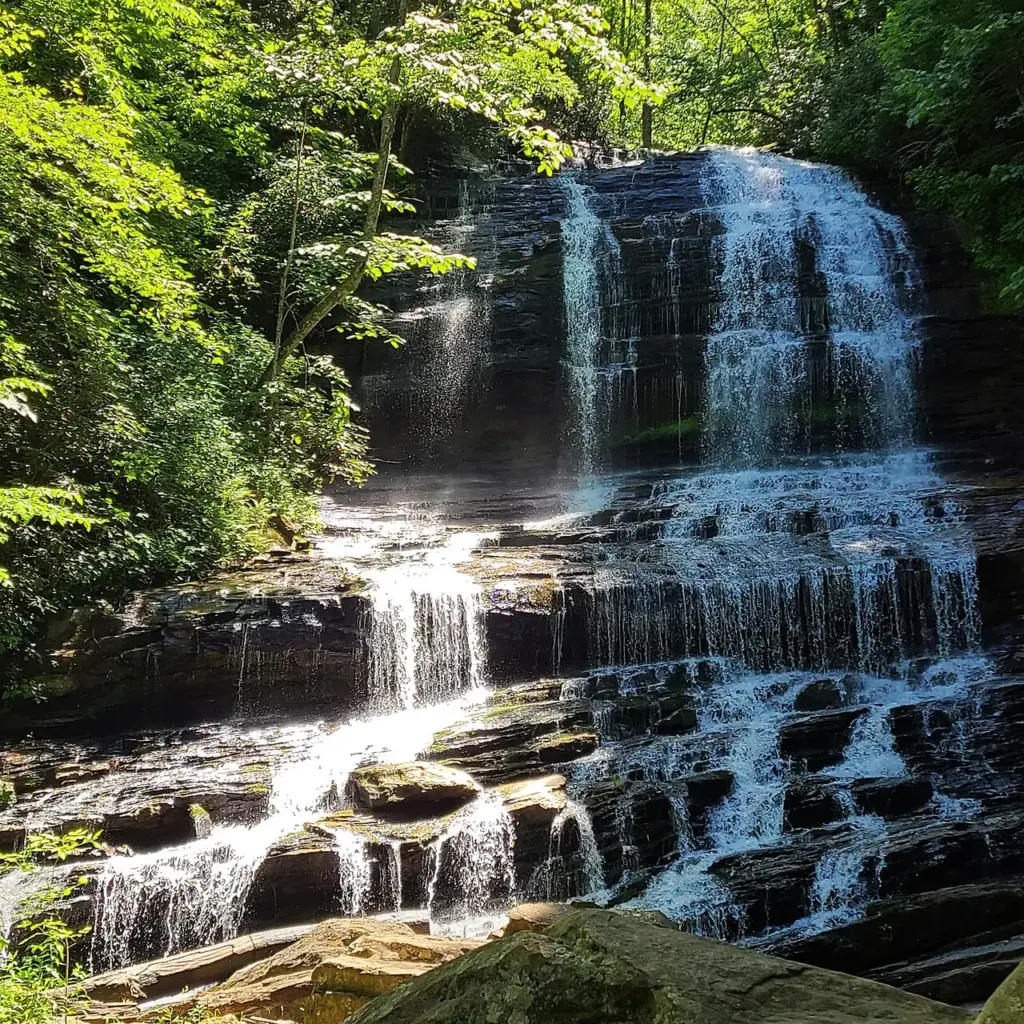
What makes Pearson’s Falls special
Pearson’s Falls is a 90-foot waterfall in a 268-acre wildlife and bird sanctuary in the foothills of western North Carolina, off Highway 176 between Tryon and Saluda. The fall is reached by a moderate quarter-mile trail, and the walk is as much the point as the water: the glen holds more than 200 species of rare wildflowers and plants, along with mosses, lichens, shrubs and trees.
The sanctuary is a piece of old forest, classified as a deciduous climax forest, with native forest, granite and spring-fed streams across its 268 acres. It is owned and maintained by the Tryon Garden Club, a non-profit, which keeps the place as a refuge rather than a developed attraction.
Its neighbours are close. Pacolet Falls is 1.2 miles away and Leland Falls 1.2 miles away, so the Tryon and Saluda area holds several falls within a short drive.
Source: Wikipedia
Geology and background
The glen is a deciduous climax forest, which means the trees and plants here have settled into the community the land supports at its fullest. Granite and spring-fed streams run through it, and the mix of mosses, lichens, shrubs and trees is what makes the sanctuary worth visiting beyond the fall itself. The wildflowers are the reason the place has its reputation: more than 200 rare species grow in a small area.
Plan your visit
Getting there and parking
- GPS: 35.2149894, -82.3360708 — Get directions
The sanctuary sits off Highway 176 between Tryon and Saluda, and the fall is a moderate quarter-mile walk in. Navigate by coordinates rather than by name. Map apps often send waterfall searches to the wrong parking lot or the far side of the stream. Download an offline map before you lose signal.
Best time and crowds
No stream gauge is linked to Pearson’s Falls, so recent rain is your best guide. Expect the most water in spring and after heavy rain. In a dry spell, especially late summer and early fall, the same fall can look half the size. Spring is also when the wildflowers are at their best, which is the other reason to come.
This is a small sanctuary, not a big park, and it stays quiet outside the flower season. Even so, an early start is the best way to have the glen to yourself.
Safety
Stay on marked trails and behind railings. Wet, mossy rock near the brink is the most common cause of serious injury. Never climb the cascade or stand at the top edge, even when the flow looks gentle. Plunge pools hide cold water, strong currents and submerged logs.
What to bring
- Shoes with real grip
- A rain shell for the spray
- Water and a snack
- An offline map or screenshot
- A dry bag for your phone
- A bag to pack out trash
Practical tips
- Come in spring for the wildflowers: more than 200 rare species grow in the glen.
- Pair it with Pacolet Falls, 1.2 miles away, or Leland Falls, 1.2 miles away.
- Screenshot the directions and these coordinates before you leave town.
- Walk slowly on the quarter-mile trail: the plants are the point as much as the fall.
Keep exploring
- More waterfalls in North Carolina
- Explore North Carolina waterfalls
- Pacolet Falls (1.2 mi away)
- Leland Falls (1.2 mi away)
- Big Fall Creek Falls (2.0 mi away)
- Explore the map
Leave a waterfall report